Wednesday, 27 September 2017

Network Classification

Transcript of COMPUTER NETWORK CLASSIFICATION ACCORDING TO THEIR GEOGRAPHICAL AREA


How are networks classified?
Networks are classified in many ways and one way is according to the geographical area. There are many types, but some are: LAN, MAN and WAN. a group of LAN form a network MAN and a group of MAN form a WAN. Each one has a different scope:


MAN
Metropolitan Area Network, a data network designed for a town or city. In terms of geographic breadth, MANs are larger than local-area networks (LANs), but smaller than wide-area networks (WANs).

LAN
Local Area Network , a computer network that spans a relatively small area. Most LANs are confined to a single building or group of buildings.LANs are capable of transmitting data at very fast rates, much faster than data can be transmitted over a telephone line, but the distances are limited

WAN
Wide Area Network, a computer network that spans a relatively large area. Computers connected to a wide area network are often connected through public networks, such as the satellite system. The largest existing WAN is the Internet


Network Topology

What is Network Topology

Network topology is the topological structure of the computer network. Network topology can be physical or logical. The logical topology describes the network dataflows from one device to the next. The physical topology is the arrangement of the different elements of the computer network such as computers, cables and other devices. The physical topology shows the cabling layout of the network, the locations of the nodes and interconnections between cables and nodes. A network logical and physical topologies can be the same.
There are the following basic types of the network topologies:

Bus Network Topology
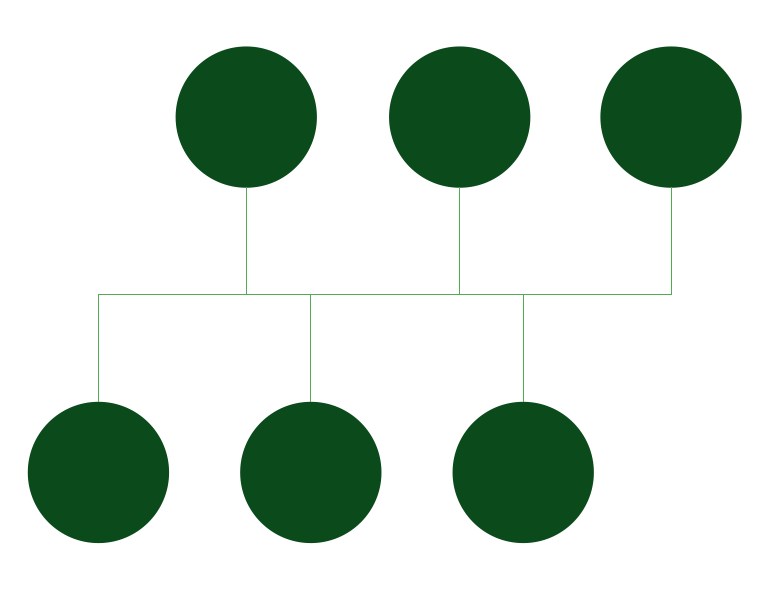
In local area networks where bus topology is used, each node is connected to a single cable. A signal from the source travels in both directions to all machines connected on the bus cable until it finds the intended recipient. If the data matches the machine address, the data is accepted, otherwise the machine ignores the data. Since the bus topology consists of only one wire, it is rather inexpensive to implement when compared to other topologies. However, the low cost of implementing the technology is offset by the high cost of managing the network. Additionally, since only one cable is utilized, it can be the single point of failure. If the network cable is terminated on both ends and when without termination data transfer stop and when cable breaks, the entire network will be down.
Bus Network Topology
Pic. 1. Bus Network Topology

Star Network Topology
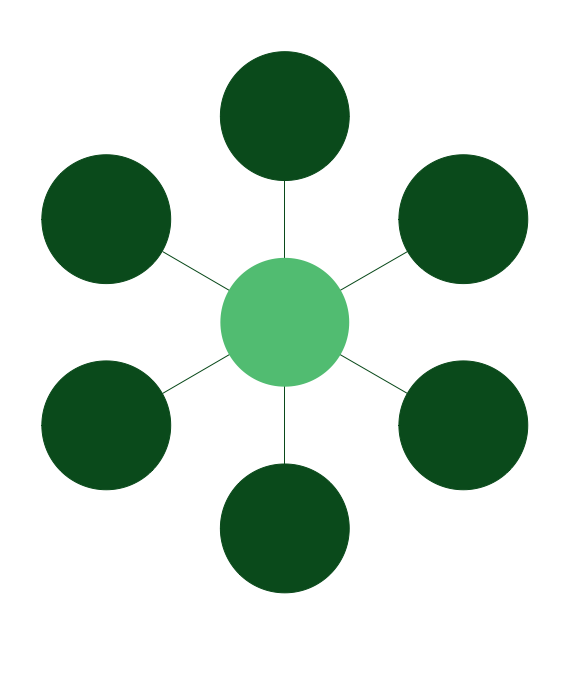
In local area networks with a star topology, each network host is connected to a central hub with a point-to-point connection. In Star topology every node (computer workstation or any other peripheral) is connected to central node called hub or switch. The switch is the server and the peripherals are the clients. The network does not necessarily have to resemble a star to be classified as a star network, but all of the nodes on the network must be connected to one central device. All traffic that traverses the network passes through the central hub. The hub acts as a signal repeater. The star topology is considered the easiest topology to design and implement. An advantage of the star topology is the simplicity of adding additional nodes. The primary disadvantage of the star topology is that the hub represents a single point of failure.
Star Network Topology
Pic. 2. Star Network Topology

Ring Network Topology
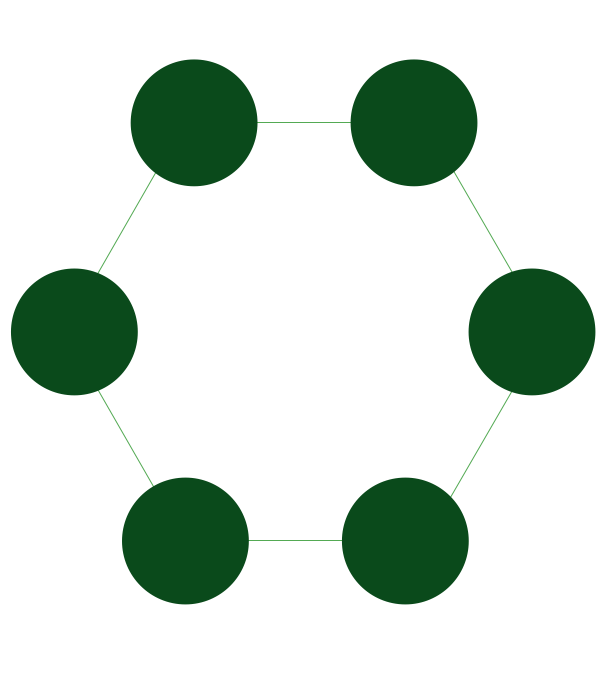
A network topology that is set up in a circular fashion in which data travels around the ring in one direction and each device on the ring acts as a repeater to keep the signal strong as it travels. Each device incorporates a receiver for the incoming signal and a transmitter to send the data on to the next device in the ring. The network is dependent on the ability of the signal to travel around the ring. When a device sends data, it must travel through each device on the ring until it reaches its destination. Every node is a critical link.
Ring Network Topology
Pic. 3. Ring Network Topology

Network Classification

Transcript of COMPUTER NETWORK CLASSIFICATION ACCORDING TO THEIR GEOGRAPHICAL AREA How are networks classified? Networks are classified...